FR
 EN
 ZH
 DE
 RU
 ES
 JA
 KO
 AR

Buying candy from local wholesalers is often the most practical option when a business is starting out. It allows retailers and small distributors to purchase manageable quantities, replenish stock quickly, and test different products without committing to large orders.
However, as sales grow, the limitations of wholesale purchasing can become more noticeable. Unit prices may affect profit margins, product availability may become less predictable, and businesses may need more control over flavors, packaging, or private-label products.
At this stage, buying directly from a manufacturer may become a more suitable option. But higher sales alone do not mean a business is ready to make the switch. The decision should depend on repeat demand, order volume, cash flow, inventory capacity, and the ability to manage longer replenishment cycles.
Signs Your Candy Business May Have Outgrown Local Wholesalers
A business does not need to stop using local wholesalers simply because it has started growing. Instead, look for changes in purchasing patterns and operating costs that indicate direct sourcing may offer a better fit.
Your Best-Selling Candies Generate Consistent Repeat Orders
Consistent repeat orders are one of the strongest signs that a product may be suitable for direct manufacturer purchasing.
For example, a candy retailer may regularly sell gummy bears, fruit-flavored gummies, or marshmallows. If the same products sell steadily across multiple purchasing cycles, the business has a more reliable basis for estimating future demand.
This matters because manufacturers generally require buyers to purchase according to product-specific minimum order quantities (MOQs). A business needs enough predictable demand to sell through the order within a reasonable period.
Evaluate demand at the individual SKU level rather than looking only at total sales. Your business may have enough volume for direct purchasing of a few proven products while still relying on local wholesalers for slower-moving items.

Wholesale Price Differences Are Starting to Affect Your Margins
Local wholesalers provide convenience, but their prices typically include the costs associated with sourcing, warehousing, handling, and redistribution.
As purchasing volume increases, the difference between wholesale prices and direct factory pricing may become more significant.
For a business with stable demand, purchasing directly from a manufacturer can reduce intermediary costs and create more room for pricing decisions. However, compare the total purchasing cost rather than focusing exclusively on the unit price.
Freight, customs duties, storage, inventory financing, and unsold stock can reduce or eliminate the apparent savings. Direct purchasing makes financial sense only when the overall cost structure supports it.
You Need More Control Over Your Candy Products
Local wholesalers usually offer products that are already available in their distribution networks. This works well for businesses selling established products, but it can limit opportunities for differentiation.
A growing candy business may want to introduce:
- Custom flavors, colors, shapes, or coatings.
- Branded packaging for retail distribution.
- Private-label candy products.
- Product variations designed for specific customer groups or markets.
These requirements often involve direct cooperation with a manufacturer because product development and production specifications need to be coordinated at the factory level.
If product differentiation has become part of your business strategy, working with a fabricant de confiseries sur mesure may offer more flexibility than purchasing only from standard wholesale inventories.
When Your Order Volume Can Support Direct Manufacturer Purchasing
Recognizing the advantages of direct purchasing is only the first step. The next question is whether your actual purchasing volume can support a manufacturer’s order requirements.
Your Regular Demand Can Meet the Candy Manufacturer MOQ
A candy manufacturer’s MOQ is the minimum quantity required for a particular order. It can vary depending on the product, formulation, packaging, production process, and customization requirements.
Standard candy products may have different order requirements from customized products. For example, a buyer ordering an existing gummy candy product may face different conditions from one requesting a new flavor, shape, or branded packaging.
Before switching, compare your expected sales with the actual MOQ for each product you intend to purchase.
A practical calculation is:
Estimated monthly demand × planned inventory coverage = required purchasing quantity
Then compare that quantity with the manufacturer’s MOQ.
If the required purchasing quantity is consistently below the MOQ, direct sourcing may create unnecessary inventory pressure. If demand comfortably supports the order quantity, the purchasing model becomes more practical.
Do not assume that a manufacturer’s MOQ is the same across all candy categories. Confirm the requirements for the specific products, packaging, and specifications you intend to order.
You Can Consolidate Orders Around Proven Products
A business does not need to purchase every product directly from a manufacturer.
Instead, it can consolidate orders around products with established demand. For example, a distributor may have several gummy candy SKUs that account for most of its recurring sales. These products may justify bulk purchasing, while less predictable products remain sourced through wholesalers.
This approach helps businesses achieve more purchasing efficiency without taking unnecessary risks across their entire product range.
When evaluating a fournisseur de bonbons en gros, ask whether different flavors, categories, or packaging options can be combined within one order. Mixed-order arrangements may be available depending on the product lines and order requirements, so confirm the details before planning inventory around them.
Can Your Business Handle the Inventory and Cash Flow Commitment?
Meeting a manufacturer’s MOQ does not automatically mean direct purchasing is financially suitable. Larger orders require more capital and place greater responsibility on the buyer to manage stock.
You Have Enough Working Capital for Larger Orders
Wholesale purchasing often allows businesses to buy smaller quantities more frequently. Direct manufacturer purchasing may require a larger upfront commitment.
This affects cash flow because money is tied up in inventory before the products are sold.
For example, a retailer may achieve a lower unit price by purchasing several months of expected demand at once. However, if sales are slower than forecast, the business may struggle to finance new products, operating expenses, or other purchasing needs.
Before placing a direct order, account for:
- Product purchasing costs.
- Freight and import-related expenses.
- Customs duties and applicable taxes.
- Warehousing and handling.
- Cash reserved for regular business operations.
The key question is not simply whether your business can afford the order. It is whether it can afford the order without restricting other essential business activities.
Your Inventory Management Can Support Larger Stock Levels
Direct purchasing usually requires better inventory planning than buying from a local wholesaler.
Larger orders can create storage pressure, especially when a business carries multiple candy categories, flavors, and packaging formats.
Candy products also have storage and shelf-life requirements that need to be considered. Buyers should check the manufacturer’s product specifications, recommended storage conditions, and remaining shelf life at delivery.
Inventory planning should account for:
- Current stock levels.
- Average sales by SKU.
- Expected stock turnover.
- Seasonal demand fluctuations.
- Product expiration dates and storage conditions.
- Available warehouse capacity.
A lower purchase price is not an advantage if products remain in storage for too long or cannot be sold before their usable shelf life becomes a concern.
Your Business Can Plan Around Longer Replenishment Cycles
Local wholesalers may provide faster replenishment because products are already held in regional inventory.
Direct manufacturer orders generally require more advance planning. Production scheduling, order preparation, transportation, and import procedures can all affect the time between placing an order and receiving stock.
For example, LeChao lists a typical delivery timeframe of 20–30 days for standard products, while customized orders depend on order requirements and quantity. Buyers should confirm the applicable schedule for each order rather than treating a general lead time as a guarantee.
Your business should therefore maintain enough inventory to cover expected sales during the replenishment period.
If you frequently need emergency restocking or cannot forecast demand reliably, local wholesale purchasing may still be the more practical option.
When Staying with Local Wholesalers Is Still the Better Choice
Direct manufacturer purchasing is not always the best option. Local wholesalers remain useful when a business needs flexibility more than lower unit prices.
Consider continuing to purchase through wholesalers when:
- You are testing new products. Demand for a new flavor, candy format, or product category is not yet established.
- Your order volume is below the manufacturer’s MOQ. Buying larger quantities would create excess inventory.
- You need frequent, small replenishment orders. Flexible purchasing is more important than bulk pricing.
- Your product range is highly varied. You need small quantities across many SKUs rather than large quantities of a few products.
- Your working capital or storage capacity is limited. Larger orders would place pressure on daily operations.
- Demand is seasonal or unpredictable. Purchasing flexibility helps reduce the risk of carrying unsold stock.
For many candy businesses, the most practical solution is a hybrid sourcing model rather than a complete switch.
| Product or purchasing situation | More suitable sourcing approach |
|---|---|
| Proven, high-volume candy SKUs | Direct manufacturer purchasing |
| New product launches | Local wholesalers |
| Seasonal or uncertain-demand products | Flexible wholesale replenishment |
| Customized or private-label candy | Direct manufacturer cooperation |
| Small quantities across many product types | Local wholesalers |
This approach allows a business to benefit from bulk purchasing where demand is predictable while retaining flexibility for products that have not yet proven their sales potential.
How to Know If It Is the Right Time to Switch
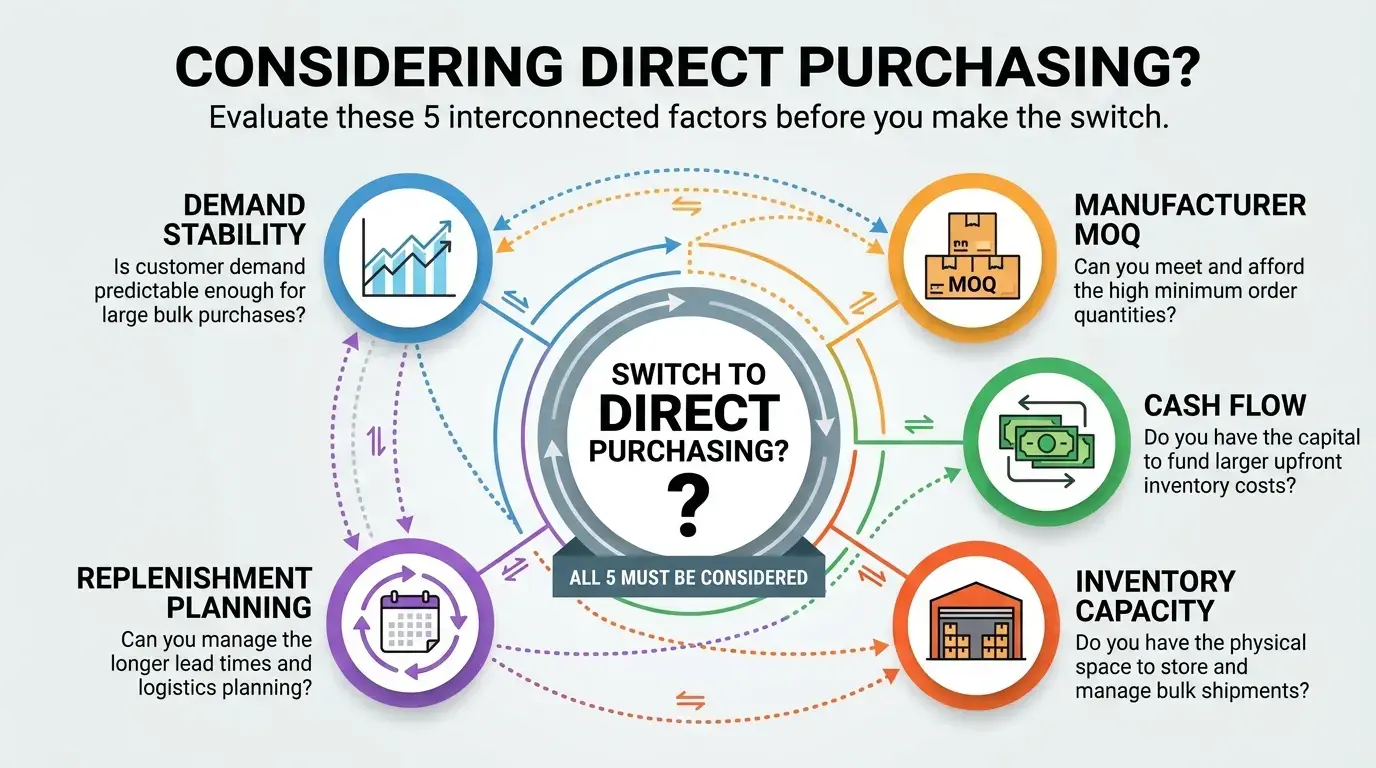
Before moving a product from local wholesale purchasing to direct manufacturer sourcing, evaluate it against five practical conditions.
| Decision factor | Questions to consider |
|---|---|
| Demand stability | Does the product generate consistent repeat orders? |
| Order volume | Can expected demand support the manufacturer’s actual MOQ? |
| Rentabilité | Do total purchasing costs still provide an advantage after freight, storage, and other expenses? |
| Cash flow | Can the business finance the order without restricting normal operations? |
| Inventory readiness | Can the business manage larger stock levels and longer replenishment cycles? |
If a product meets these conditions, direct purchasing may be worth evaluating. If several conditions remain uncertain, continuing with local wholesalers may be safer until demand or operational capacity improves.
Once the decision is made, buyers can review how distributors source candy from manufacturers to understand the practical considerations involved in working with a manufacturer.
The important distinction is that readiness to purchase directly should be established before beginning the supplier evaluation and ordering process.
Final Thoughts: Switch When Your Business Is Ready
There is no universal sales figure or business age that determines when a candy company should buy directly from a manufacturer.
The right time comes when demand is predictable, order volume can support the MOQ, and the business has enough working capital and inventory capacity to manage larger purchases.
For many businesses, a gradual transition is more practical than replacing every wholesale supplier at once. Start with proven, high-volume products and retain flexible wholesale purchasing for new or uncertain-demand items.
As an established candy manufacturer and supplier, LeChao supports wholesale, bulk, and customized candy requirements. With product categories including gummies, licorice, jelly beans, marshmallows, and chocolate candy, LeChao works with buyers to discuss product specifications and order requirements for different business needs.
Questions fréquemment posées
Is buying candy directly from a manufacturer always cheaper?
It depends. Manufacturers may offer lower unit prices by reducing intermediary costs, particularly for larger orders. However, buyers must also account for freight, customs duties, storage, inventory financing, and potential unsold stock. Direct purchasing is more cost-effective only when the total purchasing cost is lower.
What order volume do candy manufacturers usually require?
There is no universal MOQ for all candy products. Requirements vary according to the product category, formulation, packaging, production process, and customization. Buyers should request the specific MOQ for each product and confirm whether different products or flavors can be combined in one order.
Can a candy business buy from manufacturers and wholesalers at the same time?
Of course. A hybrid sourcing model is often practical. Businesses can purchase proven, high-volume products directly from manufacturers while using local wholesalers for new products, seasonal items, and smaller replenishment orders. This balances purchasing efficiency with inventory flexibility.